




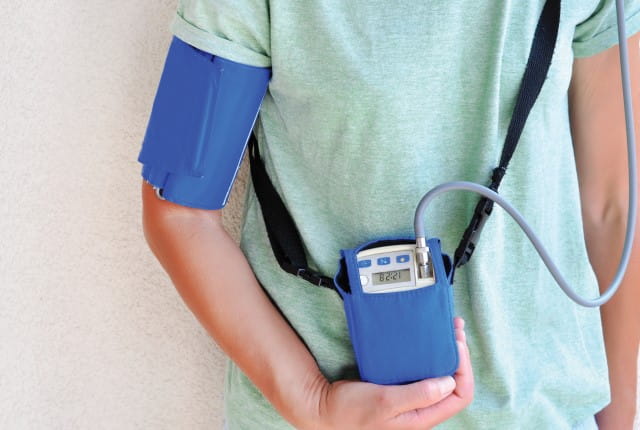
Ambulatory Blood Pressure Monitoring (ABPM), also called 24-hour blood pressure monitoring or 24 hour ABPM, measures blood pressure repeatedly across a full day and night while the patient continues normal life. A professional ambulatory blood pressure monitor (ABPM device) inflates automatically at programmed intervals and records systolic/diastolic blood pressure and heart rate. The result is an ABPM report that reveals daytime and nighttime averages, blood pressure variability, dipping pattern, and other risk signals that office BP or single-point measurements often miss.
For hospitals, ABPM is a clinical tool for hypertension diagnosis, therapy evaluation, and cardiovascular risk management. For distributors, ABPM is a scalable category: hospitals typically deploy multiple ABPM recorders, maintain ABPM cuffs in several sizes, and rely on ABPM software for reporting and follow-up, creating repeat demand over time.
What Is Ambulatory Blood Pressure Monitoring (ABPM)?
Ambulatory Blood Pressure Monitoring (ABPM) is a diagnostic method that uses a wearable ABPM recorder connected to an upper-arm ABPM cuff. The ABPM monitor automatically measures blood pressure at preset intervals—commonly every 15–30 minutes during the day and every 30–60 minutes at night (protocol dependent). Data is stored in the device and then analyzed by ABPM software to generate an ABPM report for clinicians.
ABPM vs Office BP vs Home BP Monitoring (HBPM)
• Office BP: quick and convenient, but influenced by stress, posture, and the “white coat effect.”
• Home BP Monitoring (HBPM): useful for long-term self-management, but often lacks nighttime data and standardized measurement timing.
• Ambulatory Blood Pressure Monitoring (ABPM): captures real-life BP patterns, nighttime BP, and variability over 24 hours—especially valuable for complex or uncertain cases.
In practice, ABPM is often used to confirm diagnosis when office BP and HBPM disagree or when clinicians need nighttime BP monitoring and dipping analysis.
Clinical Reasons Hospitals Use 24-Hour ABPM
1) White coat hypertension: BP elevated in clinic but normal during daily life.
2) Masked hypertension: BP normal in clinic but elevated in real life.
3) Nocturnal hypertension: elevated nighttime BP (high-risk pattern).
4) Dipping pattern classification: dipper, non-dipper, reverse dipper.
5) Resistant hypertension: uncontrolled BP despite multiple drugs.
6) Hypotension episodes: dizziness/syncope evaluation (protocol dependent).
7) Treatment evaluation: confirm medication coverage across 24 hours.
Key ABPM Report Metrics (What Clinicians Look For)
A typical ABPM report includes:
• 24-hour average SBP/DBP
• Daytime average SBP/DBP
• Nighttime average SBP/DBP
• Trend chart and time-series readings
• Dipping percentage and dipping pattern category
• Morning surge indicators (if supported)
• Blood pressure variability and statistics
• Valid reading rate (how many measurements were successful)
Hospitals value ABPM systems that deliver consistent data quality and a high valid reading rate, because retests increase cost and reduce patient satisfaction.
ABPM System Components (Keywords Hospitals & Buyers Search)
When buyers search “ABPM system” or “ambulatory blood pressure monitor system,” they typically mean the complete set:
• ABPM recorder (wearable monitor unit)
• ABPM cuff options (small/medium/large/XL adult, and pediatric if available)
• ABPM software (Windows/PC software for download, analysis, and report export)
• Data connection (USB data cable; some models add GPRS connectivity for remote transmission)
• Carry bag, charger, disposable inner cuffs (as needed for infection control)
A strong ABPM supplier should provide not only devices, but also cuff management, spare parts, and training materials for hospital workflows.
How to Choose an ABPM Device (Hospital Procurement Checklist)
Use this checklist when selecting an ABPM manufacturer or ABPM supplier:
• Comfort & wearability: size, weight, inflation comfort (important for sleep BP monitoring)
• Motion tolerance: measurement consistency during normal activity
• Interval programming: flexible schedules (5/10/15/20/30/45/60/90/120 min options are common)
• Data capacity: memory for many readings and multi-day trend support (if needed)
• ABPM software: clear ABPM report, PDF export, user-defined report content, easy printing
• Cuff ecosystem: multiple cuff sizes, replacement availability, and disposable inner cuff options
• Service & calibration: warranty terms, recommended calibration interval, spare parts supply
• Documentation: certifications and validation documents required by your target market
Hingmed ABPM Monitor Overview (WBP-02A / WBP-02A GPRS)
Hingmed offers a 24-Hour Ambulatory Blood Pressure Monitor platform designed for clinical workflows and B2B deployment. Below is a practical overview of the Hingmed ABPM monitor based on the WBP-02A series information (WBP-02A and WBP-02A GPRS).
Core product positioning (keywords covered):
• Hingmed ambulatory blood pressure monitor / Hingmed ABPM device
• Wearable 24-hour ABPM without air tube (tubeless design concept)
• Clinical level, accurate reading; motion tolerance technology
• Body position record to support physician analysis
• Hingmed ABPM software for analysis and ABPM report export (PDF)
Typical specifications and options (from WBP-02A series sheets):
• Measurement method: Oscillometric
• BP range: Systolic 40–260 mmHg; Diastolic 20–210 mmHg; Heart rate 40–200 bpm
• Accuracy: ±3 mmHg
• Battery: 1000 mAh Li battery; approx. 200 measurements (typical)
• Memory: up to 300 readings
• Interval options: 5, 10, 15, 20, 30, 45, 60, 90, 120 minutes
• Size/weight: approx. 119 × 52 × 21 mm; about 105 g (including battery)
• Data connection: USB data cable; WBP-02A GPRS adds GPRS data connection
• Cuff options: Small adult (18–26 cm), Middle adult (22–32 cm), Large adult (22–36 cm), Extra large adult (33–43 cm)
• Software environment: Microsoft Windows 2003 / Windows XP or higher (as stated on the sheets)
• Report & analysis highlights: 72-hour trend chart support, morning surge analysis, smoothness index, AASI, white coat analysis, correlation analysis, and user-defined PDF reports
If you are building an ABPM program for hospitals, Hingmed can support multi-device deployments, cuff configurations by department, and the documentation and training materials needed for distributor sales and hospital procurement.
Distributor Notes: How to Sell ABPM into Hospitals
To convert hospital accounts, sell ABPM as a clinical service package:
• Start with a pilot: 2–5 ABPM monitors + cuff set + training + sample ABPM report templates
• Build a “department map”: cardiology + nephrology + endocrinology + primary care
• Provide tender-ready materials: brochures, sample reports, software screenshots, warranty & service policy
• Create recurring revenue: cuff replacement plan, spare parts, and annual service support
Hospitals prefer ABPM suppliers that can ensure stable long-term consumables supply (ABPM cuffs) and fast after-sales response.
FAQ (Keyword Coverage)
Q: What is ambulatory blood pressure monitoring (ABPM)?
A: ABPM is 24-hour blood pressure monitoring using a wearable ambulatory blood pressure monitor that automatically measures BP throughout the day and night and generates an ABPM report.
Q: What is the difference between ABPM and home blood pressure monitoring (HBPM)?
A: HBPM is patient self-measurement at home, while ABPM measures BP automatically in real-life conditions across 24 hours, including nighttime BP monitoring and dipping analysis.
Q: How often does an ABPM device measure blood pressure?
A: Common protocols measure every 15–30 minutes in daytime and every 30–60 minutes at night, and many ABPM systems allow flexible intervals such as 5–120 minutes.
Q: What is an ABPM report?
A: An ABPM report summarizes 24-hour, daytime, and nighttime averages, trend charts, dipping pattern, variability statistics, and other analysis outputs; many systems support PDF export.
Q: What is white coat hypertension and how does ABPM help?
A: White coat hypertension is elevated clinic BP but normal out-of-office BP. ABPM helps confirm whether BP is truly high across daily life.
Q: What is masked hypertension and why is ABPM recommended?
A: Masked hypertension is normal clinic BP but elevated real-life BP. ABPM detects this pattern by measuring BP during daily activities and sleep.
Q: What is nocturnal hypertension?
A: Nocturnal hypertension refers to elevated nighttime blood pressure and is an important risk pattern best assessed with ABPM.
Q: What is a dipping pattern in ABPM?
A: Dipping pattern describes the nighttime drop in BP compared to daytime; ABPM can classify dipper, non-dipper, and reverse dipper patterns.
Q: What cuff sizes should an ABPM supplier provide?
A: Hospitals typically need multiple adult cuff sizes (S/M/L/XL), and sometimes pediatric sizes, to fit different patient arm circumferences.
Q: What should distributors ask for from an ABPM manufacturer?
A: Ask for software/report samples, cuff and spare parts list, warranty & calibration guidance, regulatory documents for your market, and training materials.
Q: Does Hingmed offer GPRS ABPM?
A: Hingmed’s WBP-02A GPRS option indicates GPRS data connection in addition to USB data cable workflows.
Q: What makes an ABPM system easier for hospitals to deploy?
A: Comfortable wearability, stable measurement consistency (motion tolerance), flexible intervals, clear ABPM software reporting, and reliable cuff/parts supply.